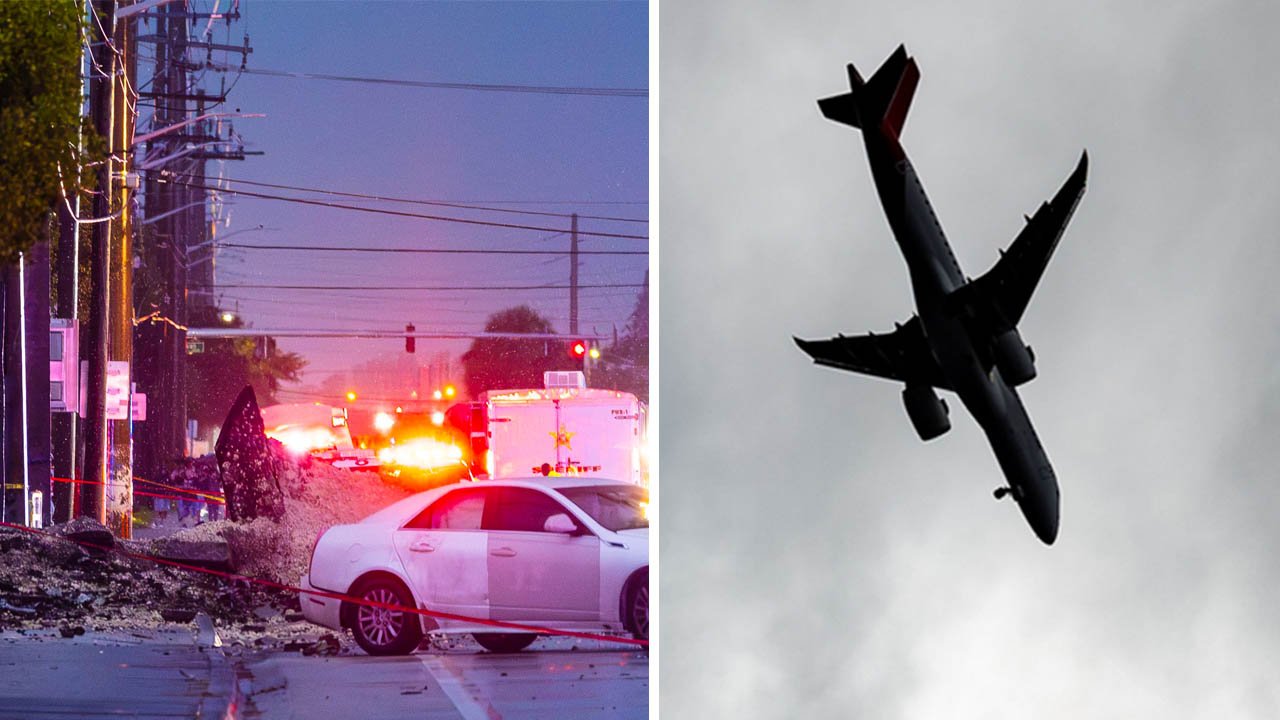

Investigators have recovered pieces of a Learjet’s tail several miles from the Florida crash site that claimed the lives of all nine people aboard. Aviation experts are now examining possible explanations for what caused the aircraft to suddenly plunge from the sky.
One week after the private jet crashed in Palm Beach County, Florida, investigators are gradually uncovering details that may help explain the tragedy.
The Learjet 60 was traveling from Austin, Texas, to the Bahamas on Sunday, November 1, when it began a rapid descent from approximately 35,000 feet before crashing into a residential neighborhood. All nine passengers and crew members lost their lives.
Those killed included technology entrepreneur Adam Robinson, 44, his wife Helen Sharp, their children Emma, four, and Charlie, two, their nanny Anita Maria Ramirez Cetina, family friends Rachael Reed and Charmi Fehr, pilot Jeff Gregory, 55, and co-pilot Nathalia Gadelha Filgueiras, 20.
Tail components discovered miles from the crash site
The National Transportation Safety Board (NTSB) reported that much of the aircraft’s left elevator, a movable section of the tail responsible for controlling the plane’s pitch, was recovered in three separate pieces. Some of the debris was located as far as 3.8 miles from the crash location.
NTSB board member Tom Chapman described the distance as significant, suggesting that these components separated from the aircraft before it struck the ground.
He explained that determining when the elevator detached could provide investigators with an important clue about other possible mechanical or environmental factors. Chapman also emphasized that weather conditions remain a major part of the investigation.
However, aviation specialists have different interpretations of the evidence. Safety expert Jeff Guzzetti told the Associated Press that he believes the elevator may have broken away as a result of the aircraft’s steep descent rather than causing it. He noted that if the component had separated at a much higher altitude, its pieces would likely have been scattered over a wider area.
Former NTSB member John Goglia has offered another possible explanation. He pointed to flight-tracking information that appears to show the aircraft briefly stabilizing at approximately 8,000 feet before beginning another steep descent.
Goglia suggested that the pilots may have placed excessive stress on the aircraft’s tail while attempting to level it, potentially causing the horizontal stabilizer to separate. Meanwhile, Law&Crime has highlighted still images from crash footage that appear to show the horizontal stabilizer missing shortly before impact, although this observation has not been officially confirmed.
Weather conditions and pilot fatigue under examination
Retired airline pilot Captain David Funk told Law&Crime that separating an elevator from an aircraft requires considerable force and would likely involve extreme structural stress.
He explained that conditions above 30,000 feet can include severe turbulence and rapidly forming clear-air icing. Depending on the aircraft’s speed and handling, these conditions could potentially contribute to a stall or a phenomenon known as a “Mach tuck,” in which an aircraft’s nose suddenly pitches downward.
Investigators are also expected to examine the pilots’ training histories, work schedules and rest periods to determine whether fatigue could have played a role. Funk raised questions about whether the crew had experienced several demanding working days with limited overnight rest.
The aircraft’s maintenance records will also be closely reviewed, including previous repairs, inspections and any signs of cracks or structural problems around the tail.
For now, investigators have not established a definitive cause of the crash, and the different theories remain under examination as authorities work to understand what happened during the Learjet’s final moments.